 Antarctica vs Arctic: Which Expedition Is Right for You?
At Wildfoot Travel, three decades of guiding travellers to the world’s great wilderness destinations has taught us that this is usually the first real fork in the road for anyone dreaming of a polar expedition: Antarctica or the Arctic?
They get lumped together constantly, because both are cold, both are white, both involve a small ship and a Zodiac. In reality, they are close to opposites: different hemispheres, different seasons, different wildlife, different governance, and a genuinely different feeling underfoot.
Here is our honest, unfiltered, head-to-head guide to the two poles, starting with the short version, then the detail behind every line of it.
Antarctica vs Arctic: At a Glance
| Antarctica | The Arctic | |
| What it is | A continent surrounded by ocean, owned by no nation | A frozen ocean ringed by 8 nations’ territory |
| Season | Late October – March (Southern summer) | May – September (Northern summer) |
| Summer temperatures | −5°C to +5°C, usually hovering around zero | 0°C to +10°C |
| Typical cost, 10–12 days | ~£6,500–£14,000pp (from ~£5,000; £20,000+ luxury) | ~£5,000–£10,000pp (from ~£3,500; £15,000+ luxury) |
| Headline wildlife | Penguins, seals, and whales – no land mammals | Polar bears, walrus, muskox, narwhal, and whales |
| Getting there | 2 days’ travel; Drake Passage crossing or fly-the-Drake | Direct/short flights to Arctic gateway towns; no ocean crossing |
| Time at sea | 1.5–2 days’ open-ocean crossing each way to reach the Peninsula | Sheltered fjord and coastal sailing from the moment you embark |
| People & culture | None – scientists only, no Indigenous population | Inuit, Sami, and Nenets communities and living culture |
| Landscape signature | Tabular icebergs, absolute white, no vegetation | Tundra, wildflowers, fjords, and drift ice |
The Fundamental Difference: A Continent vs. An Ocean
It sounds like a technicality, but it shapes everything else about the trip: Antarctica is a continent surrounded by ocean; the Arctic is an ocean surrounded by continents.
Antarctica
As a single landmass of roughly 14 million square kilometres, bigger than the United States and Mexico combined, governed by no nation. Buried beneath it is an ice sheet averaging over 2 kilometres thick and exceeding 4 kilometres at its deepest, holding around 70% of the world’s fresh water.
The Antarctic Treaty, signed by 12 countries in 1959 and now with more than 50 parties, reserves the continent for peaceful, scientific use.
There is no permanent population, only researchers rotating through more than 70 stations run by around 30 countries, numbers that swell to roughly 4,000–5,000 people in the southern summer and shrink to around 1,000 hardy winterers once the sun sets for the season.
Arctic
The Arctic is not a continent at all, but a frozen ocean ringed by the territory of eight nations, Canada, Greenland (Denmark), Norway, Sweden, Finland, Russia, Iceland, and the United States (Alaska).
Because it’s land-fringed rather than landlocked, it has been continuously inhabited for thousands of years by Indigenous peoples including the Inuit, Sami, and Nenets, and much of the ground beneath your feet on an Arctic hike is permafrost, soil that has stayed frozen for at least two consecutive years, in places for millennia.
Wildlife: Penguins vs Polar Bears
This is usually the deciding factor for our clients, and it’s a genuine either/or — the two poles do not share their headline species.
Antarctica
In Antarctica, the stage belongs to penguins: chinstrap, gentoo, Adélie, king, macaroni, and the elusive emperor. Leopard, crabeater, Weddell, fur, and elephant seals haul out on the ice alongside them.
For king penguins, South Georgia is unmatched: Saint Andrews Bay holds the largest king penguin colony in the world, with estimates ranging from around 150,000 breeding pairs upward — one of the great wildlife spectacles anywhere on the planet.

There are no native land mammals of any kind. Whales are a genuine highlight rather than a footnote — humpback, minke, orca, and fin whales are all commonly encountered, with February and March the peak of the season.
Arctic
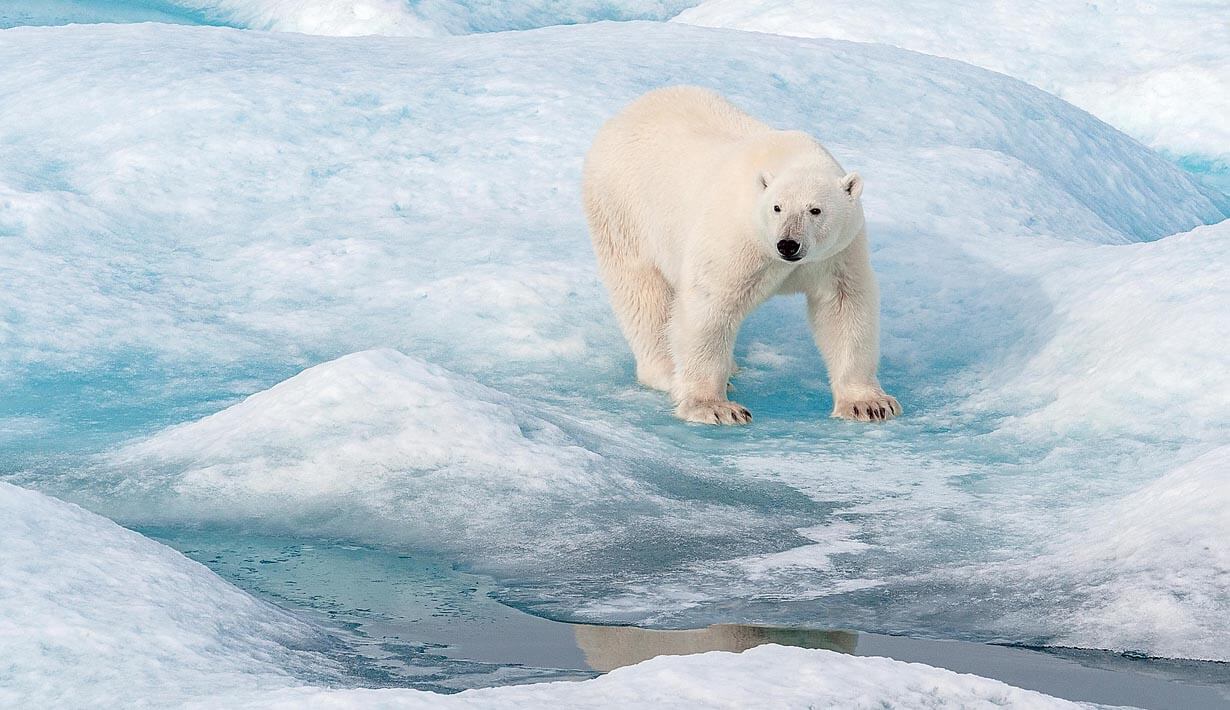
The polar bear is the animal most people come to The Arctic for — the region’s apex predator and the largest carnivore on land. Around it sits something Antarctica simply doesn’t have: true land mammals, including muskox, reindeer and caribou, and Arctic fox.
In the north, Svalbard offers the best opportunity in the European Arctic to see a bear in its true habitat, out on the sea ice — though sightings are never guaranteed there. For near-certain sightings, Churchill in Manitoba remains the more dependable choice, with bears gathering on shore each autumn.
Offshore and along the ice edge, walrus — marine mammals, despite the hauled-out beaches they’re famous for — gather in their hundreds. The whale list is longer and more varied too, with humpback, beluga, bowhead, fin, minke, and orca all commonly spotted.
Where you sail matters as much as when. The Antarctic Peninsula and South Shetland Islands are the reliable stage for Adélie, chinstrap, and gentoo penguins, while the emperor penguin, the largest and most elusive of the Antarctic penguins, breeds almost entirely on fast ice in the Weddell and Ross Seas, with Snow Hill Island the most consistently visited colony, usually reached only on specialist helicopter- or icebreaker-assisted voyages.
Walrus haul-outs are a spectacle in their own right, around Svalbard and Greenland, hundreds of Atlantic walrus can crowd a single beach, while narwhal and beluga follow the retreating sea ice edge in the high Canadian Arctic and along Greenland’s coast.
For me, Greenland is all about scale. There’s something about the icebergs there — in my mind, they felt even larger than Antarctica’s. Set against the colourful tundra and red rock of Røde Ø in ScorPeople often ask me what’s been the highlight, out of all the incredible places I’ve been lucky enough to experience. There are strong contenders.
The first time I saw a polar bear and her cubs, on our very last landing in Scoresbysund, East Greenland, is right up there. So is paddling out in Svalbard towards what looked like two black rocks in the ocean, only to realise they were humpback whales sleeping – “logging,” as it’s known – and we were so close we could feel the mist from their blowholes. – James Turner, Wildfoot Travel
But if a specific animal is the reason you’re going, the choice largely makes itself: penguins mean Antarctica, polar bears mean the Arctic.
Season and Timing: Two Opposite Summers
Because the poles sit in opposite hemispheres, their travel seasons are mirror images of each other.
Antarctica
Runs late October to March
October and November bring pristine snow, dramatic sea ice, and penguin courtship displays.
December and January offer the mildest weather, the most active wildlife, and penguin chicks on the Peninsula,at peak pricing.
February and March are the height of whale season.
Arctic
Runs May to September
May and June open the Svalbard season as birdlife returns.
June to August is the peak, under 24-hour midnight sun
August and September bring the Northwest Passage’s brief navigable window, and the first Northern Lights of the season as the sun begins to set again.
Wildfoot recommendation: if your calendar only allows for a European or North American summer holiday, the Arctic is the natural fit. If you’re free in the northern winter, Antarctica is where the season is actually open.
Getting There: Accessibility and the Journey Itself
Antarctica
Most expeditions depart from Ushuaia, Argentina (via Buenos Aires) or Punta Arenas, Chile. Traditional itineraries cross the 800km Drake Passage — typically a 1.5 to 2-day sea crossing each way — while ‘fly-the-Drake’ charter flights to King George Island skip it entirely.
Whichever route you choose, reaching the ship takes around two full days of travel from the northern hemisphere.
Arctic
Considerably closer for European and North American travellers. Gateway towns like Longyearbyen (Svalbard), Tromsø, Reykjavik, and Kangerlussuaq are reachable on direct or short connecting flights, often four to nine hours from London or New York.

There is no equivalent open-ocean crossing — embarkation is usually straightforward, and you are into sheltered fjord and coastal sailing almost immediately.
Our Antarctica route options page breaks down itinerary lengths and starting points, and our Antarctica vessels guide covers the ships.
On the other pole, see our Arctic route options for how Svalbard, Greenland, and the Northwest Passage connect into a single itinerary.
What It Costs
Both poles cover a wide range — the ship, cabin category, itinerary length, and season all move the number by thousands of pounds.
As a rule of thumb, the Arctic has the lower entry point, largely because it’s quicker to reach and doesn’t require the Drake Passage’s extra sailing days.
| Per person | Antarctica 10–12 days | Arctic (Svalbard) 8–12 days |
| Entry level | From ~£5,000–£6,500 | From ~£3,500–£5,000 |
| Mid-range | ~£6,500–£14,000 | ~£5,000–£10,000 |
| Luxury | £20,000–£40,000+ | £12,000–£20,000+ |
Figures are indicative per-person, twin-share fare ranges for 2026/27 season sailings, excluding international flights and gratuities unless stated. Prices vary by operator, ship, and date — get in touch for a quote against your specific dates.
People and Culture
If a sense of human history and living culture matters to your trip, this is a real point of difference.
Antarctica
Antarctica has never had permanent residents. There is no Indigenous population and never has been. Its human story is one of exploration rather than habitation — Shackleton, Amundsen, Scott — and the only people there today are rotating scientists at research stations.
Arctic
The Arctic has been lived in for thousands of years. Inuit, Sami, and Greenlandic communities have made their home here across generations, and voyages routinely include community visits, museums, and cultural performances. It is a living culture, not simply a historical one.
Cold, Scale, and Landscape
Both regions get described in extremes, but the reality of a summer expedition is far more comfortable than the headline statistics suggest. Around the Antarctic Peninsula in season, temperatures tend to hover between −5°C and +5°C — usually close to zero. Arctic summer temperatures typically run from 0°C to as much as +10°C. You will want good layers, not survival gear.
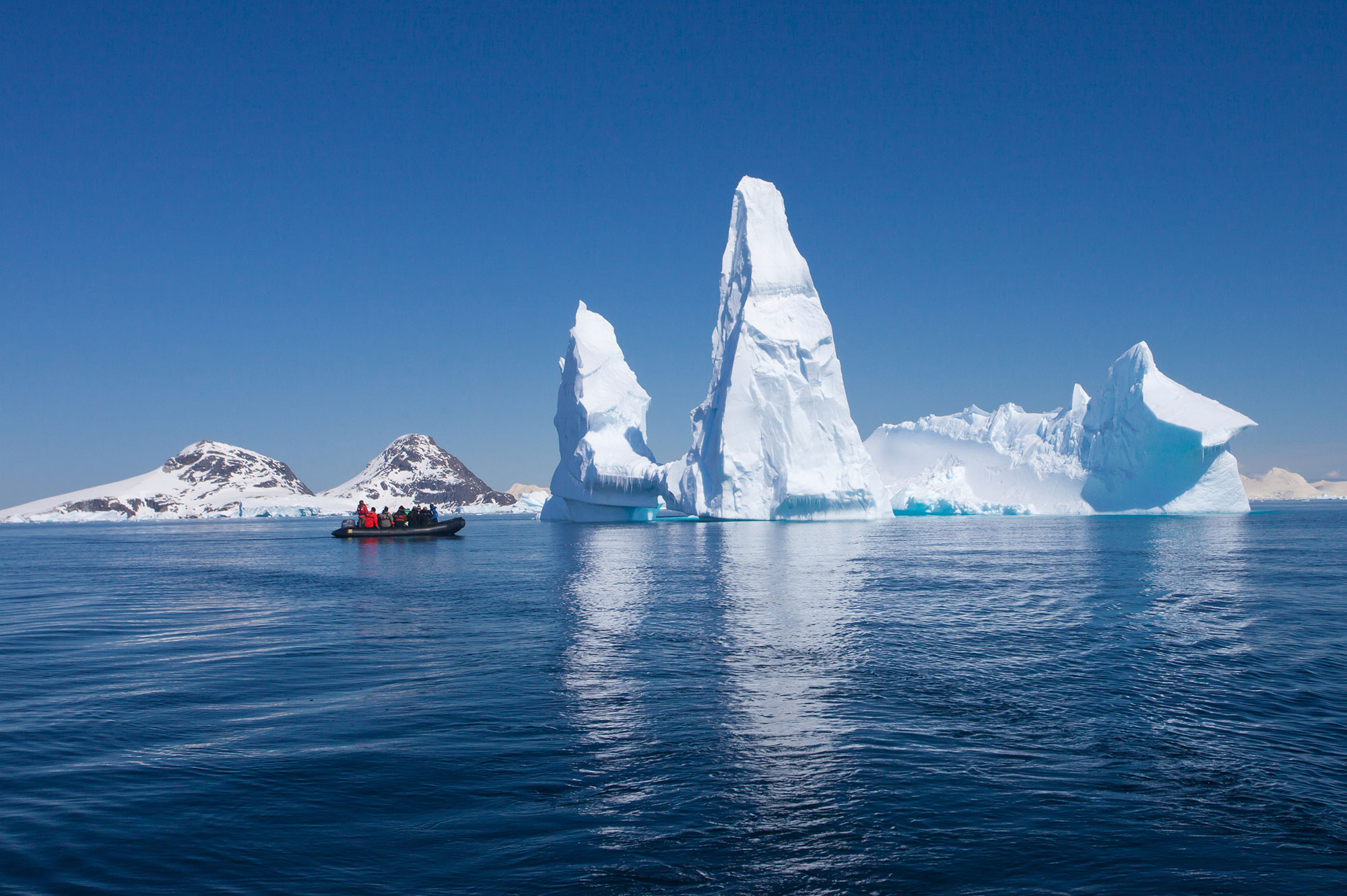
Where Antarctica genuinely does win on scale is its ice. Tabular icebergs — flat-topped, sometimes the size of small countries — are unlike anything the Arctic produces, and the continent is entirely blanketed by an ice sheet, with no vegetation to soften it.

The Arctic, by contrast, is greener in summer. Tundra, wildflowers, and moss appear as the snow retreats, and its fjords, drift ice, and calving glaciers offer a softer, more varied landscape. Arctic sea ice is thinner and far more seasonal, shrinking to a fraction of its winter extent by September — which is precisely why the Arctic cruising season is so tightly bound to those summer months.
Both share dramatic tidewater glaciers and near-24-hour summer daylight. But where Antarctica feels otherworldly and absolute, the Arctic feels wild but inhabited.
Which Pole Suits You
Beyond the headline facts, here’s how we tend to advise different types of traveller.
First-time polar travellers
For UK clients especially, we often suggest starting in the Arctic. A classic Svalbard voyage is easily reached, unmistakably polar from the moment you land, and a superb way to dip a toe into expedition travel — and it sets you up beautifully for Antarctica later.
That said, if you only ever take one polar trip, Antarctica with the Falklands and South Georgia is the one that will live far beyond any expectation, for the sheer concentration of wildlife and dramatic ice alone.
If I had to pick just one moment above all of them, it would be the first time I landed at Gold Harbour, South Georgia. A stunning panorama of jagged mountains under blue skies, a beautiful sandy beach framed by lush green tussock grass – and then, carpeting every inch of it, tens of thousands of king penguins and hundreds of elephant seals as far as the eye could see. It’s the only time in my life I’ve physically frozen in awe at the sheer magnificence of nature. My brain simply couldn’t compute the spectacle in front of me. It took several minutes before I realised I didn’t need to stand rooted to the spot – I could actually walk along the beach and find my own place to take it all in. It remains the most magical moment of my life, and I still get goosebumps thinking about it – James Turner, Wildfoot Travel
Families with older children
The Arctic’s shorter flights, gentler seas, and cultural stops tend to suit families better, especially with children under 12, who most Antarctic operators don’t accept aboard. Always check age policies directly, as they vary by ship.
Photographers
Both are exceptional, but for sheer scale and light, Antarctica’s icebergs and 24-hour December daylight are hard to beat. For a single, dramatic subject, the Arctic’s polar bears on sea ice are the more coveted shot — at the cost of a much lower hit rate.
Solo travellers
Both regions are well set up for solo travellers, with most expedition ships offering solo cabins or roommate matching. The Arctic’s shorter itineraries and lower entry point make it the easier region to try first if budget is the main consideration.
Anyone prone to seasickness
This one has a clear answer: the Arctic. Most Arctic itineraries sail sheltered coastal and fjord waters, while an Antarctic trip almost always means the Drake Passage — two open-ocean crossings, unless you choose (and pay more for) a fly-the-Drake itinerary.
The Master Checklist: Matching the Pole to Your Ambitions
Before you commit to a hemisphere, run your choice through these five filters:
Name your must-see animal
If it’s penguins, only Antarctica will do. If it’s a polar bear, only the Arctic offers a chance, and even there, a sighting is never guaranteed.
Check your calendar
Antarctica’s season runs late October to March; the Arctic’s runs May to September. Your available travel dates may decide this for you before anything else does.
Be honest about time and budget
Antarctica asks for a longer journey, more days at sea, and a higher entry point. The Arctic is quicker and more accessible to reach from Europe and North America.
Consider your sea legs
The Drake Passage is a genuine one-and-a-half to two-day ocean crossing each way, while most Arctic itineraries sail in comparatively sheltered coastal and fjord waters.
Decide what else you want from the trip
If Indigenous culture and a lived-in landscape matter to you, the Arctic delivers something Antarctica structurally cannot. If you want scale, silence, and the sense of standing on an untouched continent, that belongs to Antarctica alone.
That said, if you only ever take one polar trip, Antarctica with the Falklands and South Georgia is the one that will live far beyond any expectation, for the sheer concentration of wildlife and dramatic ice alone.
Really, every day out in the Arctic or Antarctica is special in its own way – the excitement of not knowing what the day holds, the sense that Mother Nature is unveiling a script unique to that exact moment, the unexpected encounters with local Inuit communities that always leave a warm place in my heartesby Sund, the contrast is magnetic for photographers; the ice seems to pop right off the landscape – James Turner, Wildfoot Travel
Frequently Asked Questions
Is Antarctica or the Arctic colder?
Antarctica, though not in a way most travellers experience. Expedition season around the Peninsula sees temperatures hovering between −5°C and +5°C, usually close to zero, while Arctic summers run from 0°C to around +10°C. Both are comfortable with good layers.
How do the costs compare?
The Arctic generally has the lower entry point. A typical 8–12 day Svalbard voyage starts below an equivalent Antarctic Peninsula sailing, largely because it’s quicker to reach and doesn’t require the extra sea days of the Drake Passage. Both regions offer everything from simple expedition ships to genuine six-star vessels.
Can you see penguins and polar bears on the same trip?
No — not in the wild. Penguins are exclusively Southern Hemisphere and polar bears are exclusively Arctic; their ranges never overlap. Seeing both means booking two separate expeditions, one to each pole.

Which is easier to get to?
The Arctic. Gateway towns like Longyearbyen, Tromsø, and Reykjavik are a direct or single-connection flight from most of Europe and North America. Antarctica requires flying to Ushuaia or Punta Arenas at the southern tip of South America, plus a Drake Passage crossing or charter flight to reach the ship itself.
Is the sea crossing to Antarctica rough?
It can be. The Drake Passage has a reputation for a reason, though modern stabilised ships and X-BOW® hull designs have made the crossing considerably more comfortable than it once was. ‘Fly-the-Drake’ itineraries avoid it entirely for an added cost.
Which is better for a first-time polar traveller?
If you’re planning to visit both poles eventually — and we’d highly recommend it — start with the Arctic. Svalbard is the quintessential Arctic experience, easily accessible from the UK, and sets you up beautifully for an Antarctic expedition in future.
If you’ll only ever make one trip, Antarctica with the Falklands and South Georgia just about wins it.
Talk to Us
There is no wrong answer between Antarctica and the Arctic — only the trip that matches what you actually want to see, when you’re free to travel, and how you want to feel when you get there.
We have sailed both. We know the ships, the seasons, and the small details — which crossing suits a nervous sailor, which month gives you cubs or chicks, which itinerary is worth the extra cost — that make the difference between a good trip and the trip of a lifetime.
Get in touch with the Wildfoot Travel team to help you choose your polar adventure, or start browsing our Antarctica cruises and Arctic cruises for yourself.