Svalbard vs. Greenland: Two Arctic Expedition Experiences
Ask most people to picture the Arctic and they’ll describe something close to Svalbard: pack ice, a polar bear, mountains rising straight out of a frozen sea. Ask them again after they’ve been to Greenland and they’ll describe something entirely different; an iceberg the size of a cathedral drifting past a village of red and yellow houses.
At Wildfoot Travel, three decades of guiding travellers to the world’s great wilderness destinations has taught us that Svalbard and Greenland get grouped under the same three-word heading far more often than they deserve to be.
Both sit well inside the Arctic Circle. Both deliver ice, wildlife and midnight sun. But we’ve come to think of them less as alternatives and more as two different chapters of the same story, and there’s a good case for reading them in order.
Here’s how they actually differ, and which one we’d send you to first.
Svalbard: The Quintessential Arctic
Svalbard is the Arctic doing exactly what you hoped it would.
You land at Longyearbyen, a three-hour flight from Oslo, which is part of the appeal and the transition is immediate. This is a working Arctic town at 78° north, ringed by glaciers, where the road out of the settlement ends at a polar bear warning sign and everything beyond it is wilderness. There is no gradual approach. You are simply there.
What follows is one of the richest concentrations of wildlife in the European Arctic. Polar bears are the headline, and Svalbard offers the best chance anywhere of seeing one in its true element, out on the pack ice, though nobody who knows the region will promise you a sighting.
Around 300 bears live on the archipelago year-round, part of a wider Barents Sea population of roughly 3,000 that ranges north onto the sea ice and east into Russian territory.
Around them is a supporting cast that few destinations can match: walrus hauled out in their hundreds, Arctic fox working the base of the bird cliffs, and a reindeer subspecies found nowhere else on the planet, stockier and shorter-legged than its mainland cousins. In the fjords, beluga, humpback, minke and fin whales feed through the summer, with blue and bowhead whales turning up on rare and memorable occasions.

The landscape holds its own against any of it. This is classic High Arctic scenery, ice-capped peaks dropping into black water, glacier fronts calving into fjords. On a full circumnavigation you push north to the pack ice at 80°, which is about as far as most travellers will ever get toward the pole.
And then there’s the human layer, which surprises people. Svalbard has no Indigenous population and never has, but it has an extraordinary history of people trying, and often failing, to make something of it. Pyramiden sits abandoned since the Cold War, a Soviet mining town frozen mid-sentence.
Somewhere on the ice north of here, S. A. Andrée launched a hydrogen balloon in 1897 in an attempt to reach the North Pole; the expedition’s fate wasn’t known for thirty-three years. And beneath the permafrost outside Longyearbyen, the Global Seed Vault holds the backup copy of the world’s crops. It’s a place that has always attracted people with slightly outsized ideas.
Greenland: The Scale of Things
Greenland is not a bigger version of Svalbard. It’s a different proposition altogether.
Start with the obvious: this is the world’s largest island, roughly 80% of it buried beneath an ice sheet up to three kilometres thick. The Northeast Greenland National Park alone is the largest national park on earth. Scale isn’t a feature of a Greenland trip, it’s the entire subject.
That scale shows up most dramatically in the ice. At Ilulissat, the glacier Sermeq Kujalleq, one of the fastest and most productive in the Northern Hemisphere, calves icebergs into Disko Bay at a rate that has made the icefjord a UNESCO World Heritage Site. On the east coast, Scoresby Sund opens into the largest fjord system in the world, where the red rock of Røde Ø rises above water crowded with ice.
For me, Greenland is all about scale. There’s something about the icebergs there — in my mind, they felt even larger than Antarctica’s. Set against the colourful tundra and red rock of Røde Ø in Scoresby Sund, the contrast is magnetic for photographers; the ice seems to pop right off the landscape – James Turner, Wildfoot Travel
The second thing Greenland has that Svalbard doesn’t is people, and not as a historical curiosity, but as a living culture.
Around 56,000 people live here, the great majority Greenlandic Inuit, whose ancestors have occupied this coast for thousands of years. Voyages call at settlements strung along the shoreline, painted in reds and blues and yellows against the rock.
There’s Norse history layered underneath it too: Erik the Red’s farming colonies date to around 985 CE, and their ruins are still standing in the south.
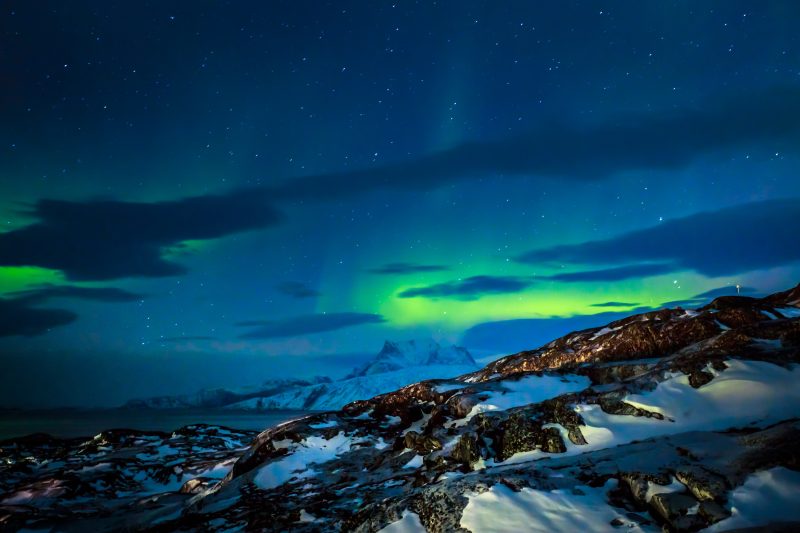
What Greenland asks of you in return is a lower wildlife expectation. Polar bears are here, but they’re concentrated in the remote north and northeast and far less reliably seen than in Svalbard. You’ll find muskox, Arctic hare and Arctic fox ashore, and humpback, fin and minke whales offshore, with bowhead an occasional bonus. But the animals aren’t the organising principle of the trip. The landscape and the culture are, and they’re big enough to fill it.
Which brings us to the thing most people miss about Greenland’s scale, which isn’t the icebergs at all.
Scale in Greenland isn’t only about the giants — the bergs, the glaciers, the mountains. It’s just as much about getting down on your knees. In autumn the tundra turns to crimson, gold and rust, dark berries threaded through it, a carpet running as far as the eye can see. And what you’re crouching beside is a forest. These plants grow so slowly that an Arctic willow stem thickens by around a tenth of a millimetre a year — less than the width of a human hair. The dwarf birch colouring the ground around your boots can be more than a century old. That, for me, is the real scale of Greenland.” – James Turner, Wildfoot Travel
So Which One First?
If you’re likely to make more than one polar journey in your life, and most people who make one end up making two, we’d send you to Svalbard first.
The reasoning is practical as much as romantic. Svalbard is the easiest of the two to reach from the UK, the season is well defined, and the sheer breadth of what you’ll see, from bears and walrus to that endemic reindeer, makes it feel unmistakably polar from day one. It is the quintessential Arctic experience, and it sets you up beautifully for everything that follows, including Antarctica, whenever you get there.
Greenland rewards a traveller who already has a frame of reference. Once you’ve stood on a Svalbard deck watching pack ice, the sheer scale of Scoresby Sund lands differently. And if you have the time, you don’t strictly have to choose, there are itineraries that combine Spitsbergen and East Greenland in a single voyage, some of them under sail, timed for the returning Northern Lights in late summer.

When to Go
Svalbard’s cruise season runs May to August. May and June catch the pack ice still retreating, which can mean strong early-season bear encounters. June to August is the peak, under 24-hour daylight. From September the archipelago largely closes to vessel-based exploration and shifts to a land-based winter offering husky sledging and snowmobile expeditions, with the polar night running roughly November to January.
Greenland’s ship season runs June to September. June to August is the peak, with midnight sun and whales working Disko Bay. By late August and into September the sky darkens enough for the first Northern Lights of the season. Greenland also offers a completely separate winter trip: February to April, land-based around Ilulissat, built around dogsledding and aurora.
Summer temperatures in both sit comfortably between 0°C and +10°C. Good layers, not survival gear.
Getting There
Svalbard is the simpler journey by some margin: a direct or one-stop flight via Oslo or Tromsø into Longyearbyen, around three hours from Oslo, and a single straightforward embarkation point.
Greenland is more fragmented, though improving quickly. Most routings go via Reykjavik or Copenhagen, then a further connection to Nuuk, Kangerlussuaq, or seasonally direct to Ilulissat.
Nuuk’s international airport opened in November 2024 and Qaqortoq’s in April 2026, with Ilulissat’s own international airport due later in 2026, all of which is steadily shortening the journey. East and Northeast Greenland, including Scoresby Sund and the National Park, remain reachable only by expedition ship.

Our Arctic route options page sets out how these connect, and the Northeast Greenland voyage gives a sense of the wilder side.
What It Costs
Both destinations span a wide range depending on ship, cabin and season. Svalbard generally has the lower entry point, largely a function of the shorter, simpler journey; Greenland’s longer itineraries and more complex routing push its typical range higher.
| Per person | Svalbard, 8–12 days | Greenland, 8–15 days |
| Entry level | From ~£3,500–£5,000 | From ~£5,000–£6,500 |
| Mid-range | ~£5,000–£10,000 | ~£6,500–£13,000 |
| Luxury | £12,000–£20,000+ | £14,000–£24,000+ |
Figures are indicative per-person, twin-share fare ranges for 2026/27 season sailings, excluding international flights and gratuities unless stated. Prices vary by operator, ship, and date — get in touch for a quote against your specific dates.
Svalbard and Greenland: At a Glance
Everything above, in one place.
| Svalbard | Greenland | |
| In a phrase | A mecca for wildlife and classic Arctic landscapes | Landscape heaven, and a living Inuit culture |
| What it is | Norwegian Arctic archipelago, no Indigenous population | World’s largest island; autonomous Danish territory and Inuit homeland |
| Population | ~2,900, mostly international residents | ~56,000, majority Greenlandic Inuit |
| Season | May–August by ship; winter land-based options | June–September by ship; separate Feb–April land season |
| Wildlife | Polar bears, walrus, Arctic fox, endemic reindeer, whales | Muskox, Arctic hare and fox, whales; polar bears a remote bonus |
| Headline sight | Pack ice at 80° north, polar bear and walrus encounters | Ilulissat Icefjord in the west; the giant fjords of Scoresby Sund in the east |
| Getting there | One direct or short flight via Oslo or Tromsø | Via Reykjavik or Copenhagen, then a Greenlandic connection |
| Culture | Polar history — whaling, mining, ill-fated expeditions | Living Inuit communities, colourful settlements, Norse ruins |
| Typical cost | ~£5,000–£10,000pp (from ~£3,500) | ~£6,500–£13,000pp (from ~£5,000) |

Frequently Asked Questions
Is Svalbard or Greenland better for seeing polar bears? Svalbard, clearly. Around 300 bears live on the archipelago year-round, part of a wider Barents Sea population of roughly 3,000, and itineraries are built specifically around searching the ice edge. Greenland’s bears are concentrated in the remote north and northeast and are far less reliably encountered. Worth noting that neither offers guaranteed sightings — for that, Churchill in Manitoba is the more dependable destination, though it’s a very different style of trip.
Which should I visit first? Svalbard, if you’re likely to travel to the Arctic more than once. It’s the more accessible journey from the UK, the most complete introduction to Arctic wildlife, and an excellent foundation for both Greenland and a future Antarctic expedition.
Can you visit both on one trip? Yes — there are itineraries combining Spitsbergen and East Greenland in a single voyage, typically in August and September, some of them under sail and timed for the returning Northern Lights. It makes for a longer trip, but it’s the most efficient way to see both.

Which has better Northern Lights? Neither during the main summer season, when both sit under 24-hour daylight. Greenland has the edge outside it: a dedicated winter trip to Ilulissat between February and April combines dogsledding with genuine aurora viewing. Late-season voyages to either destination in September can also catch the first displays.
Is Svalbard part of Norway? Yes, though governed under the distinct 1920 Svalbard Treaty, now honoured by 49 signatory nations, which restricts the islands to non-military use and grants visa-free access to citizens of treaty countries.
How cold does it get? Far less than people expect. Summer temperatures in both destinations typically run between 0°C and +10°C. You’ll want proper layers and a good waterproof, not expedition survival kit.
Talk to Us
There’s no wrong answer between Svalbard and Greenland. There’s only the question of which one you’re ready for, and in what order.
We’ve sailed both, and we know the details that don’t show up in a brochure — which month gives you the best chance at the ice edge, which itinerary gets you into the icefjord in the right light, which extra connection is worth making and which isn’t.
Get in touch with the Wildfoot Travel team, or start browsing our Svalbard tours and Arctic cruises.